-
The Power by Naomi Alderman: Gender Inequalities and Power.
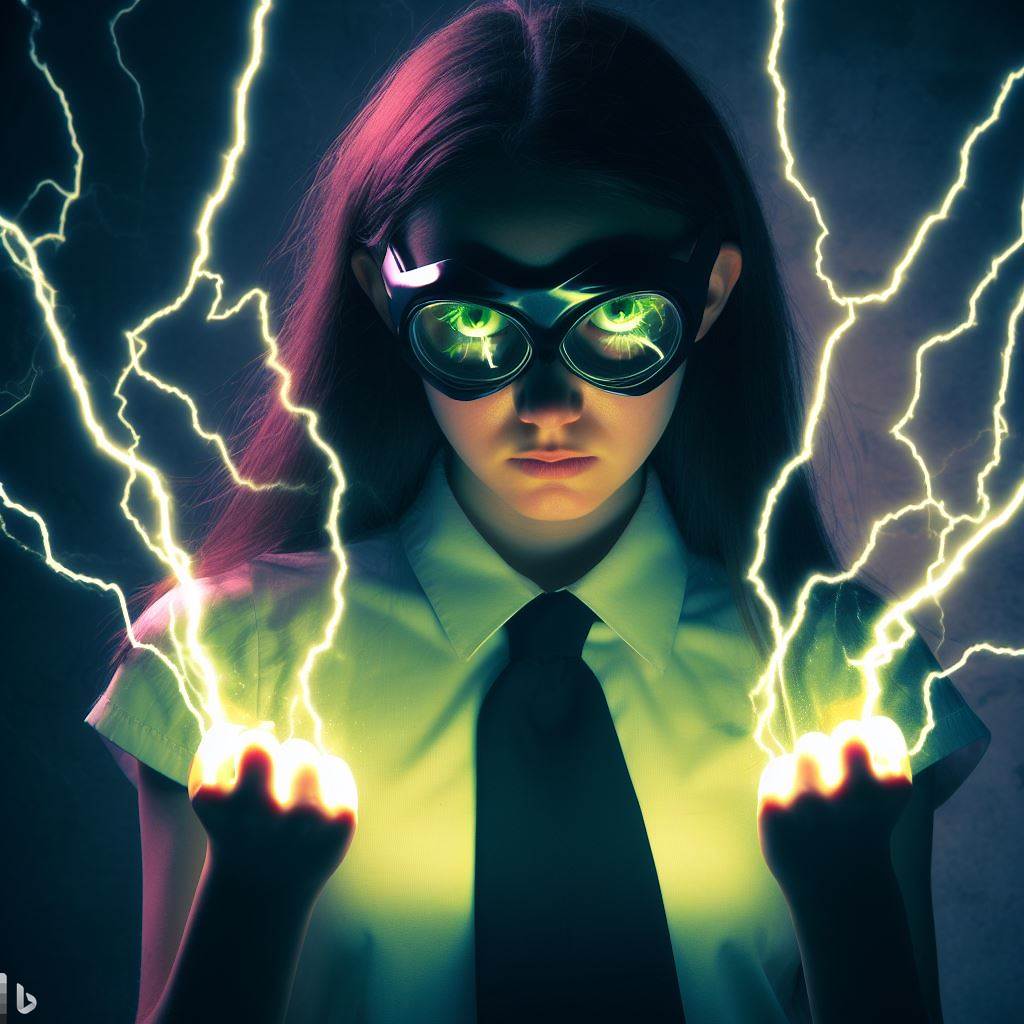
In the era of #MeToo and the accelerating popularisation of feminist ideas, “The Power” by Naomi Alderman is not just a highly relevant book, but it also gives a provocative critical view on certain modern issues in gender (in)equality. In this piece of speculative fiction, the author envisions a world where the social positions of men and women got switched because teenage girls everywhere in the world suddenly discovered that their bodies could produce a deadly electrical charge. Alderman keeps her story grounded in the lives of four characters: Roxy – the daughter of a London crime boss, Margot – an ambitious U.S. politician, Allie – an abused foster child, and Tunde – a young Nigerian who is reporting on the world’s gender revolution (Alderman 2016).
Chapter by chapter, Alderman goes from one character to another, following their adventures and personal developments throughout societies in radical transformation (Charles 12.10.2017). The twist in Alderman’s novel is that gender revolution and transformation to matriarchy does not result in a utopian peaceful and fair world, as has been envisioned by many authors before (Gilman 2007; King 2017), but rather becomes a dystopian reality filled with violence, injustice, and suffering.
Using new schematics of sex and power, this provocative story not only deconstructs many obvious expressions of daily sexism but also encourages the reader to think about power and privilege and the way they can corrupt any person, no matter their gender. As a contemporary example, it is enough to remember Aung San Suu Kyi, the female head of the Myanmar government who has allowed the horrific Rohingya crisis to happen where entire villages were burned to the ground, families were separated and killed, and women and girls were gang-raped (United Nations 2019; Reuters 30.08.2018).
In fact, the very assumption that the world under the rule of women would automatically be a better place is inherently sexist as it employs an archetype of a woman as a gentle, loving, naturally non-violent creature (unless she is a lesbian, of course) (Gilbert 2002). Alderman’s work shows the intrinsic feature of unequal distribution of power, i.e., the potential for its abuse. This means that as important as it is to give more power to a disadvantaged group, that alone will not solve the problems, as power can (and most likely will) be abused.So, do we effectively address gender inequalities assuming that they arise from power abuse? Indeed, one of the book’s central ideas is that the problem of power abuse can arguably be named as the main reason for gender inequality. What complicates things is that a person in a privileged position often does not fully realize the benefits and possibilities intrinsic to their position. The way I see it, our task is to make individuals acknowledge their privileges and the responsibilities that those imply towards people who do not have these privileges.
This tendency can be illustrated by siblings’ relations. I have an older sister and a younger brother. When my sister was 14, I was 11 and my brother was 5 we would sometimes fight, as all siblings do. My sister was physically and intellectually stronger than me and so, most of the time in a conflict she would end up getting what she wanted either by physical force or by tricking me. Both my sister and I would sometimes fight with our 5-year-old brother. Guess who would usually win those fights? Obviously, our parents would intervene and punish us for abusing our power. However, it was not what my and my sister’s “natural” thinking was. We had the power – we used it when need be to get what we wanted. Until we learned not to.
Whether we like it or not, men today are still in a position of power. While our society predominantly focuses on female empowerment as a way to combat gender inequality (Leach 12.03.2016; United Nations 2016), in my opinion, it fails to draw enough attention to the urgent necessity to educate men about the unfair distribution of power and teach them to be aware of the privileges they have and the responsibilities they imply. We should encourage men and boys not only to stop abusing their power but also to use it to accelerate the process of female emancipation.
Coming back to my example, if my parents had failed to explain to me and my sister the responsibilities we have towards our brother, he might have spent a part of his childhood under our control. Even if they had put a lot of effort into explaining to my brother (the person affected) that he was being treated unfairly by his sisters (the perpetrators) and that he should challenge our unfair treatment, it would not have been enough to change our behavior.
This idea also finds its reflection in research. For example, LSE scholar Sarah Ashwin who researched gender inequality in Russia, observed that a more equal distribution of domestic workload is documented in families where men actively encourage it, and not in those where women earn more or where women demand it more persistently (Ashwin and Isupova 2018). That is not to say that women cannot change their situation, but rather that gender equality is much easier to achieve by making men allies, not enemies. It is even more so, considering the fact that any significant social change requires resources and that, at the moment, men predominantly control economic assets, political power, cultural authority, and armed forces – the resources required to implement women’s claims for justice (Connell 7.10.2003).
To sum up, Alderman’s “The Power” is a perfect example of how creating utopian or dystopian scenarios can illuminate deficiencies of the present social order and the ways we are trying to improve them. This novel shows that matriarchy can be as dangerous as patriarchy and the reason for it lies in the human inability to always use power responsibly. If we transfer this idea to the current situation with gender inequality, we can conclude that we are not addressing this problem effectively. Along with the continuous work on female empowerment, we have to focus our efforts on educating men and boys who hold the power, on their responsibilities to facilitate gender equality.
References:- Alderman, Naomi (2016). The Power. Viking: London. ISBN: 9780670919987.
- Ashwin, Sarah and Olga Isupova (2018). “Anatomy of a Stalled Revolution: Processes of Reproduction and Change in Russian Women’s Gender Ideologies”. In: Gender & Society 32(4), pp. 441–468. ISSN: 0891-2432. DOI: 10.1177/0891243218776309.
- Charles, Ron (12.10.2017). “Book review: Naomi Alderman delivers in “The Power”. In: The Washington Post.
- Connell, R. W. (7.10.2003). The Role of Men and Boys in Achieving Gender Equality.
- Gilbert, Paula Ruth (2002). “Discourses of Female Violence and Societal Gender Stereotypes”.In: Violence Against Women 8(11), pp. 1271–1300. ISSN: 1077-8012. DOI: 10.1177/107780102762478019.
- Gilman, Charlotte Perkins (2007). Herland. Echo Library: Twickenham. ISBN: 9781406809367.
- King, Stephen (2017). Sleeping Beauties: Roman. Heyne: München. ISBN: 9783453271449.
- Leach, Anna (12.03.2016). “12 steps to achieve gender equality in our lifetimes”. In: The Guardian.
- Reuters (30.08.2018). “Aung San Suu Kyi won’t be stripped of Nobel peace prize despite Rohingya crisis”. In: The Guardian.United Nations (2016). Achieve gender equality and empower all women and girls.
- United Nations (2019). Rohingya Refugee Crisis.
You May Also Like
Homoparentalité